


Description
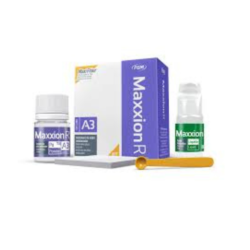
Maxxion C Cement FGM is a conventional glass ionomer luting cement designed for cementing indirect restorations and orthodontic appliances. It delivers reliable adhesion, radiopacity for diagnosis, and low solubility that helps ensure long-lasting restorations.
Moreover, its balanced consistency allows clinicians to manipulate and place the cement easily during clinical procedures.
Package Includes
Powder – 15 g
Liquid – 10 g
Key Benefits of Maxxion C Cement
Low solubility for improved cement longevity
Excellent consistency for easy cementation
Radiopaque formulation for clear radiographic diagnosis
Versatile compatibility with different restorative materials
Reliable sealing for indirect restorations
Excellent Handling Properties
Maxxion C Cement offers a smooth and workable consistency, therefore clinicians can mix and place the material quickly and accurately. In addition, the controlled viscosity helps dentists seat restorations properly without applying excessive pressure.
Radiopaque for Accurate Diagnosis
The radiopaque formulation allows dentists to identify the cement clearly on radiographs. Consequently, clinicians can evaluate restorations more accurately and detect excess cement after treatment.
Versatile Clinical Applications
Dentists use it in several restorative and orthodontic procedures.
Cementation of crowns
Cementation of bridges
Cementation of inlays and onlays
Cementation of orthodontic bands
Fixation of orthodontic appliances such as Haas expanders
Cavity lining under restorations
However, when stronger adhesive bonding becomes necessary for indirect restorations, dentists should use resin cements such as Allcem or Allcem Core.
Maxxion C Cement Step-by-Step Clinical Protocol
Properly isolate the operative field.
Ensure enamel and dentin surfaces are clean and slightly moist.
The internal surface of the restoration may be sandblasted with aluminum oxide to improve micromechanical retention.
Shake both powder and liquid bottles before dispensing.
Recommended proportion: 1 spoon powder : 1 drop liquid.
Mix half of the powder with the liquid initially.
Gradually add the remaining powder until a homogeneous paste is formed.
Apply a thin layer of cement inside the restoration.
Seat the restoration with light to moderate pressure.
Remove excess cement after 5–7 minutes using an explorer.
Frequently Asked Questions
A: It functions as a conventional glass ionomer luting cement used for the cementation of indirect dental restorations and orthodontic appliances.
A: Yes, dentists commonly use it to cement crowns, bridges, inlays, and onlays, especially when reliable seating and sealing are required.
Yes, it provides radiopacity, so dentists can easily evaluate the cement and restoration during radiographic examination.
A: Yes, orthodontists frequently use it to cement orthodontic bands and appliances, including expanders and other fixed devices.
A: Clinicians should mix one scoop of powder with one drop of liquid to achieve the proper working consistency.







Reviews
There are no reviews yet.