
Description
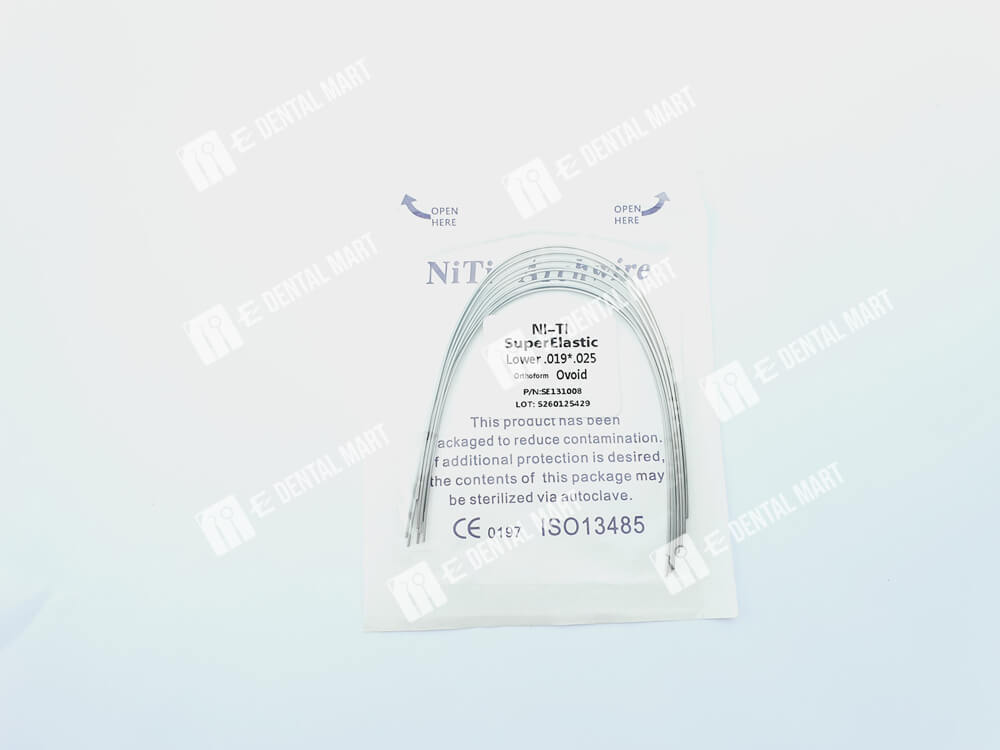
Orthodontic rectangular wires made from natural nickel-titanium (NiTi) are designed for intermediate to finishing stages of braces treatment, where precise tooth control becomes essential. These wires combine the superelastic properties of NiTi with a rectangular cross-section, allowing orthodontists to achieve better torque expression, angulation control, and bracket engagement while maintaining patient comfort.
Because of their shape-memory effect, these wires consistently return to their original form after deflection. As a result, they deliver light and continuous forces that support controlled and efficient tooth movement.
Key Advantages of Orthodontic Rectangular Wires
-
Controls tooth angulation and root torque more effectively than round wires
-
Maintains arch form with minimal permanent deformation
-
Improves bracket engagement for better force transmission
-
Reduces patient discomfort compared to stiff stainless steel wires
-
Supports efficient tooth movement with fewer wire changes
Main Clinical Uses
Intermediate Stage of Treatment
After initial alignment with round wires, orthodontists introduce orthodontic rectangular wires to begin precise root and tooth positioning.
Torque Control
These wires help control root movement within the bone, not just crown alignment, which improves long-term stability.
Rotation and Angulation Correction
The rectangular profile engages the bracket slot more fully, allowing better correction of rotation and tipping.
Arch Form Maintenance
Thanks to the NiTi shape-memory effect, the wire preserves the planned arch shape throughout treatment.
Space Closure Support
Orthodontic rectangular wires assist with controlled space closure mechanics, especially after premolar extractions.
Preparation for Final Stages
They prepare teeth for transition to heavier stainless steel rectangular wires by improving root alignment in advance.
Light-Force Finishing (Sensitive Cases)
In patients requiring gentler forces, these wires offer a more comfortable alternative to rigid steel wires.
Key Benefits of Orthodontic Rectangular Wires
-
Excellent three-dimensional tooth control
-
Light, continuous forces for biologically favorable movement
-
Smooth transition from alignment to finishing phases
-
Reduced treatment time through efficient force delivery
-
Improved comfort during rectangular wire stages
-
High durability with resistance to permanent deformation
-
Natural, non-coated finish with no risk of peeling
Material & Design Features of Orthodontic Rectangular Wires
Material:
Nickel-Titanium (NiTi) with superelastic and shape-memory properties
Surface Finish:
Natural metallic (silver-gray), smooth and polished to reduce friction
Cross-Section:
Rectangular (e.g., 0.016″ × 0.022″, 0.017″ × 0.025″, 0.018″ × 0.025″, 0.019″ × 0.025″)
Flexibility:
More rigid than round wires, yet more flexible than stainless steel
Force Delivery:
Consistent light forces supporting torque, rotation, tipping, and root positioning
Temperature Response:
Some variants activate optimally at body temperature for gentle force release
Why Choose Orthodontic Rectangular Wires?
These rectangular wires provide the ideal balance between control and comfort. They allow orthodontists to move beyond basic alignment while avoiding the stiffness of stainless steel. Therefore, they play a critical role in achieving predictable, stable orthodontic results.
Frequently Asked Questions
A: Orthodontists introduce rectangular archwires after initial alignment to improve control of tooth position and root movement.
A: Rectangular designs engage bracket slots more fully, which allows better control of rotation, angulation, and torque.
A: They deliver light and continuous forces that move teeth effectively while minimizing discomfort.
A: Yes, clinicians use them to guide controlled tooth movement during space closure mechanics.
A: Yes, the nickel-titanium alloy helps preserve the intended arch form throughout orthodontic progression.









Reviews
There are no reviews yet.